How to plan an AI brand visibility tracking project
Choose the brands, questions and AI assistants to track, then agree how your team will review and use the results.

You've decided that tracking your brand's visibility in AI-powered search matters. Smart move. But now comes the harder question: where do you actually start?
AI brand visibility tracking isn't something you can set up in an afternoon. It requires thought about which competitors to monitor, which questions to track, which AI platforms matter most, and how you'll turn all that data into action. Skip the planning phase and you'll end up with noisy data that doesn't tell you much. Get it right and you'll have a clear view of your competitive position in one of the fastest-growing discovery channels.
Here's how to approach the planning process, from defining your scope to building a timeline that actually works.
Start by defining what you're trying to learn
Before you configure anything, get clear on your objectives. AI visibility tracking can answer many different questions, but trying to answer all of them at once leads to unfocused results.
Ask yourself what you most need to understand. Are you trying to establish a baseline for how often your brand gets mentioned? Do you want to compare your visibility against specific competitors? Are you looking for content gaps where you're missing from conversations you should be part of?
Most businesses find it helpful to focus on three or four core objectives. A typical starting point might include establishing baseline visibility metrics, monitoring share of voice against key competitors, identifying answer gaps where you're absent but shouldn't be, and understanding which sources influence AI recommendations in your category.
Write these objectives down. They'll guide every decision that follows, from which prompts to track to how you structure your reporting.
Build your brand and competitor inventory
The next step is deciding exactly which brands to monitor. This sounds obvious, but it requires more thought than you might expect.
Start with your own brand. Document not just your primary brand name but every variation that might appear in AI responses. This includes common misspellings, abbreviations, product names, and any aliases customers might use. If you're "Acme Solutions" but people sometimes call you "Acme" or "AcmeSol", you need to track all three.
Then identify your competitors. Aim for three to five key rivals, enough to give you meaningful competitive context without drowning in data. Choose competitors that actually compete for the same customer queries, not just companies in your general industry. A boutique accounting firm should track other boutique firms, not the Big Four.
For each competitor, note their domain and any aliases. The more complete your inventory, the more accurate your tracking will be.
Develop your prompt strategy
Prompts are the questions you'll track across AI platforms. They're the heart of any visibility tracking programme, and getting them right matters enormously.
Think about how your customers actually search when they're looking for solutions like yours. What questions do they ask? What problems are they trying to solve? What comparisons do they make?
Organise your prompts into categories based on intent. Discovery prompts are broad research questions like "What are the best tools for X?" Comparison prompts pit options against each other, like "Brand A vs Brand B, which is better?" Recommendation prompts signal purchase readiness, such as "What should I buy for Y?" Problem-solving prompts focus on specific challenges, like "How do I fix Z?"
Aim for 50 to 100 prompts to start. That's enough to give you statistically meaningful data without making the project unmanageable. Tag each prompt by category, topic, and priority so you can slice your results later.
Don't guess at prompts. Mine your existing data for ideas. Look at search queries that bring people to your website, questions your sales team hears repeatedly, topics that perform well in your content marketing, and queries you're targeting in paid search. These are all signals of what your customers actually ask.
Configure your monitors
Monitors define the context for running your prompts. They specify which geographic markets, languages, and AI platforms you want to track.
Start by listing the markets that matter most to your business. If you sell primarily in the UK, that's your priority. If you're targeting the US and Europe, you'll need separate monitors for each region. AI responses can vary significantly by location, so don't assume what's true in one market applies everywhere.
Then decide which AI platforms to include. At minimum, track the major players: ChatGPT, Claude, Perplexity, and Gemini. Each platform has different training data and generates different responses. You might find strong visibility on one platform and near-invisibility on another. That's valuable information.
Set your refresh frequency based on how quickly you need insights and your budget constraints. Daily monitoring catches changes quickly but costs more. Weekly monitoring is often sufficient for establishing trends without excessive spend.
Plan your implementation timeline
A realistic AI visibility tracking project takes eight to 12 weeks from kickoff to full operation. Trying to compress this timeline usually means cutting corners that hurt data quality.
The first two weeks focus on foundations. You'll get your API access sorted, create your project in whatever tracking system you're using, and configure your brand and competitor inventory. This is also when you verify that everything connects properly.
Weeks three and four are for prompt development. This is where you draft your full prompt list, categorise and tag everything, and review the list with stakeholders who understand your customers. Don't rush this phase. Prompts that don't reflect real customer behaviour generate data you can't act on.
Weeks five and six cover monitor setup. You'll create monitors for each market, assign prompts to the right monitors, and configure your AI platform selection and refresh schedules. Run initial tests to make sure everything fires correctly.
Weeks seven and eight establish your baseline. Run your full prompt set across all monitors, review the raw responses for accuracy, validate that brand detection is working properly, and document your starting metrics. This baseline becomes the benchmark against which you'll measure all future progress.
The final phase, weeks nine through 12, focuses on operationalising everything. Build your dashboards and reporting templates, set up automated runs, configure alerts for significant changes, and train your team on interpreting the results. By the end, you'll have a system that runs reliably and generates actionable insights.
Define your success metrics
You need clear targets to know whether your tracking programme is working. Establish KPIs before you start collecting data, not after.
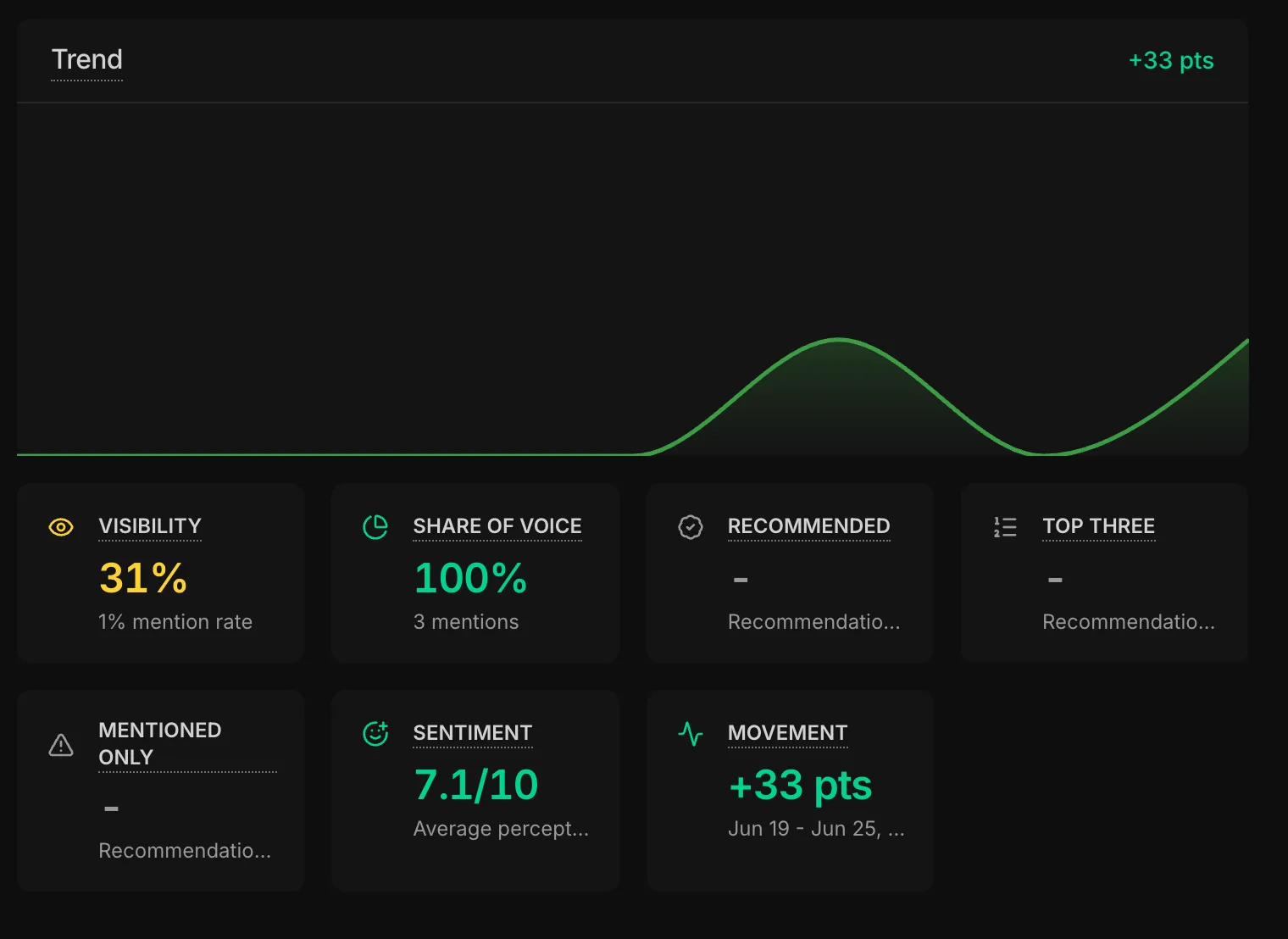
Visibility score gives you a composite view of your overall presence in AI responses. Share of voice measures your brand's mention percentage relative to competitors. Mention rate tracks how often you appear at all across relevant queries. Average position shows where you rank when you do get mentioned. Sentiment score indicates whether mentions are positive, neutral, or negative.
Set realistic targets based on your starting position. If your baseline share of voice is 15%, aiming for 50% in three months isn't credible. But targeting 20% might be achievable with focused effort.
Track secondary metrics too, particularly answer gap count and citation coverage. These point directly to improvement opportunities and help you prioritise where to focus your content and PR efforts.
Assign clear ownership
AI visibility tracking generates insights, but insights only matter if someone acts on them. Define roles and responsibilities upfront.
You'll need a project manager to keep the implementation on track, a technical lead to handle API integration and data pipelines, a content strategist to develop prompts and interpret gap analysis, and a data analyst to build dashboards and surface trends. In smaller organisations, one person might wear multiple hats. That's fine, as long as the responsibilities are clear.
Also identify who owns the response to insights. When tracking reveals a significant answer gap, who decides what content to create? When sentiment drops, who investigates why? Without clear ownership, data becomes something people look at rather than something that drives action.
Start smaller than you think
Here's the most important planning advice: resist the urge to track everything immediately. Start with one market, your top 50 prompts, and three or four AI platforms. Get that working reliably before expanding.
A focused pilot generates cleaner data, surfaces problems faster, and lets you refine your approach before scaling up. You can always add more prompts, more markets, and more platforms once you've proven the model works.