Your Google rank says nothing about whether AI recommends you
Search rankings and AI recommendations measure different aspects of brand visibility. How to track both.

SEO tracks your visibility in links. AEO/GEO tracks your visibility in answers. They are different problems, and they need different tools.
SEO and AEO/GEO solve two different visibility problems. SEO measures where your website ranks among the links on a search results page. AEO/GEO, answer engine optimisation and generative engine optimisation, measures whether AI engines name and recommend your brand inside the answers they write. SEO is about position. AEO/GEO is about being in the answer at all.
That distinction is no longer academic. Gartner predicted in February 2024 that traditional search engine volume would fall 25% by 2026, as people move to AI chatbots and virtual agents. By July 2025, Google's own AI Overviews reached 2 billion users a month, a figure Alphabet confirmed on its Q2 2025 earnings call. And in a G2 survey published in March 2026, 51% of B2B software buyers said they now start product research with an AI chatbot more often than with Google. In April 2025, that figure was 29%.
So the question every marketing leader needs to answer is no longer only "where do we rank". It is "what does AI say about us, and is it recommending us or someone else".
Why does AEO/GEO matter for your brand now?
It matters now because your buyers have already moved, and most measurement has not followed them.
Buyers increasingly begin research inside an AI engine. Forrester's 2026 Buyers' Journey Survey, which covered nearly 18,000 business buyers, found that generative AI and conversational search were named the most meaningful research source twice as often as any other option. That puts AI ahead of vendor websites, product experts, and sales representatives.
An AI answer behaves nothing like a results page. When a buyer asks ChatGPT or Perplexity for options, they get a short written answer with three or four named brands. They do not get 10 links to scroll. If your brand is not in that answer, you are not on page two. There is no page two.
You also cannot see this with the tools you already own. AI engines give different answers to different people, in different wording, on different days. There is no equivalent of Search Console telling you how often you appeared, in what context, and next to which competitors. Without structured tracking, you are guessing.
The next two years are when this stops being optional. The G2 figure moved from 29% to 51% in under a year. SEO measurement took most of a decade to become standard practice. AEO/GEO measurement is on a much faster curve. The brands that start now will have a clear read on their position while competitors are still guessing at theirs.
If you have never checked, the first useful step is to look. You can see what AI engines say about your brand with Cleotic.
How is AEO/GEO different from SEO?
AEO/GEO and SEO measure different things, reward different work, and fail in different ways. SEO is a contest for position in a list. AEO/GEO is a contest to be named inside an answer. One more link on page one helps your SEO. It does nothing for whether ChatGPT recommends you.
The table below sets the two side by side.
Traditional SEO
AEO/GEO
What it measures
Your ranked position in a list of links
Whether AI engines name your brand in their answer
The unit of visibility
A link
A sentence inside a written answer
Where the buyer sees you
On a results page they scroll
Inside an answer they read and trust
What winning looks like
Page one, ideally the top three
Cited in the answer, described accurately, ahead of rivals
How you check it
Rank trackers and Search Console
Prompt-based monitoring across each AI engine
What you influence
Keywords, backlinks, technical health
The quality and consistency of what AI engines can find about you
What failure looks like
Page two
Absent from the answer, or described wrongly
There is also a dimension SEO never had. AEO/GEO is not only about whether you appear. It is about how you are described. "A solid choice for mid-market teams" and "an option some users find expensive" can both be true, and an AI engine may serve either one. You need to know which version your buyers are reading.
Why can't your SEO tools track AEO/GEO?
SEO tools cannot track AEO/GEO because they were built to read a different thing. A rank tracker watches a results page. It counts positions, keywords, and backlinks. It was never designed to read a generated answer, judge whether your brand is named, or compare how four AI engines describe you on the same question.
The data is also harder to collect. An AI engine does not publish a visibility report. To see your standing, someone has to ask each engine the questions your buyers ask, record the answers, repeat the exercise over time, and make sense of the variation between engines and weeks. Done by hand, that is a slow and inconsistent job. Done once, it tells you almost nothing, because the answer next week may differ.
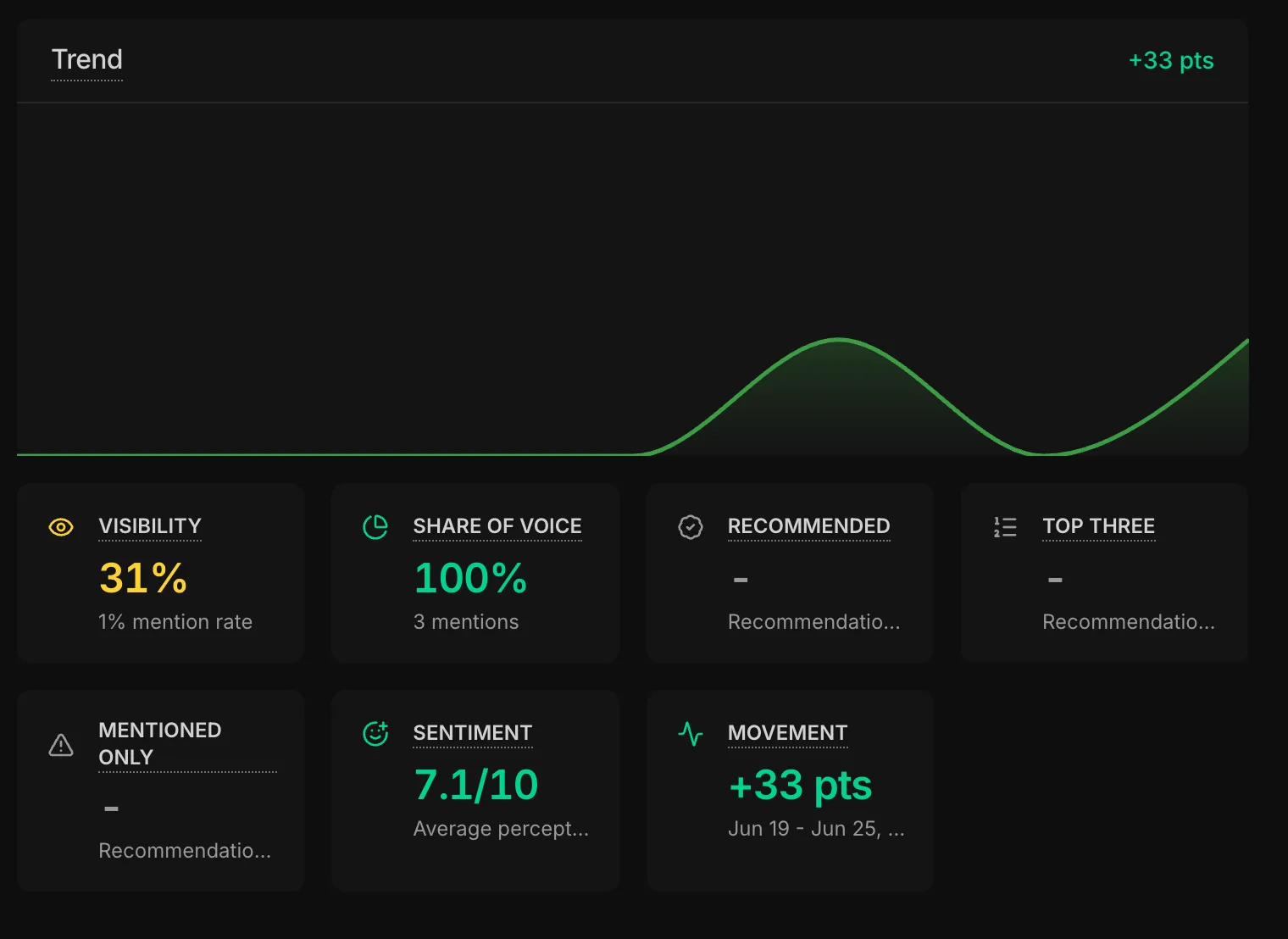
This is the gap Cleotic was built for. Cleotic is an AI brand visibility tracker for marketing teams. It runs your brand through buyer-intent prompts across ChatGPT, Gemini, Claude, and Perplexity. It records whether you are named, where you sit in the answer, and which competitors appear beside you. You see all of it in one place. SEO tools answer "where do we rank". Cleotic answers "what does AI say about us".
Where to start with AEO/GEO
You do not need a budget or a new team to begin. You need to look at the answer your buyers are already seeing. Start here.
- Ask the questions your buyers ask, in plain language, inside ChatGPT, Gemini, Claude, and Perplexity.
- Record whether your brand is named, how it is described, and which competitors share the answer.
- Check every major engine, because a strong showing in one tells you little about the others.
- Repeat the check on a schedule, because a single look is a snapshot and not a measurement.
- Treat a missing or inaccurate answer as a real problem with a named owner, the same way you would treat a page-two ranking.
Track AI answers alongside search rankings. Record whether assistants recommend your brand, how they describe it and which sources they cite.