Metrics that matter for AI brand visibility
What share of voice, position, sentiment, mention rate and citation coverage tell you about your brand in AI answers.

Millions of people now bypass traditional search engines entirely, asking AI assistants for recommendations instead. The brands that show up in those responses have a significant advantage. The brands that don't are invisible to a growing audience.
But how do you measure something as fluid as AI-generated recommendations? You can't just check a ranking like you would with Google. You need different metrics designed for this new reality. Here's what to track and what each metric actually tells you.
Share of voice tells you who's winning the conversation
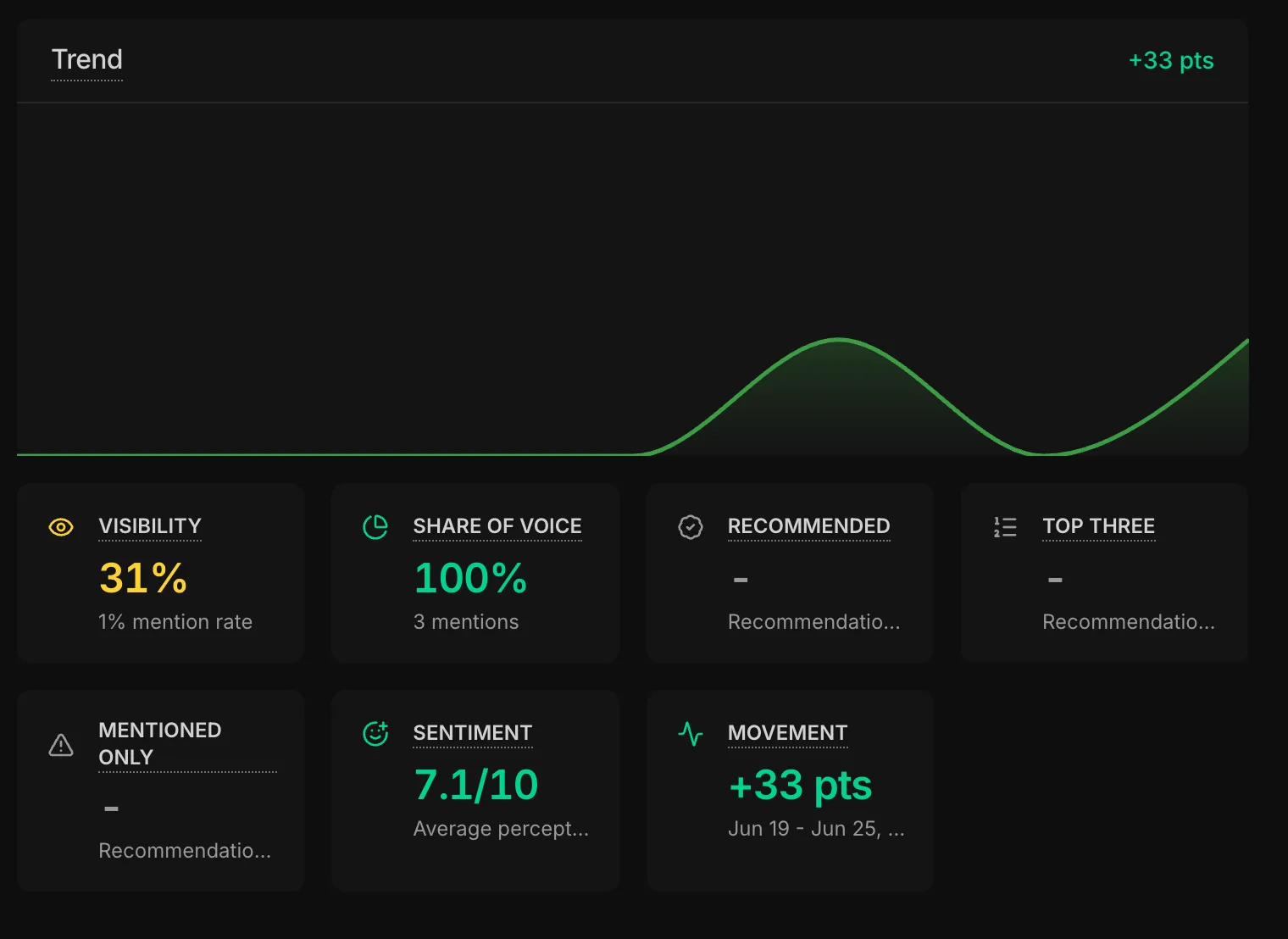
Share of voice is the metric that answers the big-picture question: when AI assistants talk about your category, how much of that conversation belongs to you?
Think of it this way. If someone asks an AI for the best options in your space, the response might mention five or six brands. Share of voice measures what percentage of all those brand mentions across all relevant queries are yours. If you have a 25% share of voice, you're getting mentioned a quarter of the time. Your competitors are splitting the other 75%.
This metric matters because it reflects your overall visibility relative to the competition. A high share of voice means AI assistants see your brand as a relevant answer in your category. A low share means you're being overlooked, even when the AI is discussing exactly the problems you solve.
Track share of voice across different query types to understand where you're strong and where you're weak. You might dominate questions about pricing but disappear entirely when people ask about specific features. That's actionable insight you can use to focus your content and marketing efforts.
Position shows where your brand appears
Getting mentioned is good. Getting mentioned first is better.
Position measures where your brand appears in AI-generated recommendations. When an AI lists several options, the order matters. Brands mentioned early get more attention and carry more implied endorsement. Being third or fourth on the list is vastly different from being the first name out of the gate.
This metric is especially important because AI responses shape perception. If your brand consistently appears after competitors, users start to see you as a secondary choice, even if your product is objectively better. First-position mentions build authority. Later mentions suggest you're one of many alternatives.
Average position across all queries gives you a useful benchmark. But dig deeper into specific query categories. You might be first for "best budget option" queries but fifth for "best premium option" queries. That tells you something important about how AI assistants categorise your brand and where you need to shift the narrative.
Sentiment shows how AI assistants frame your brand
Not all mentions are created equal. A brand mentioned positively as a top recommendation is very different from a brand mentioned as "an option to avoid" or "outdated compared to competitors."
Sentiment analysis tracks whether AI responses frame your brand positively, neutrally, or negatively. It looks at the context around mentions, the adjectives used, the comparisons made, and the overall tone of the recommendation.
This metric is your early warning system. A drop in positive sentiment might indicate that AI models are picking up on negative reviews, outdated information, or unfavourable comparisons being published online. Since AI assistants draw from a wide range of sources, sentiment shifts can reveal problems in your broader online presence that you might not otherwise notice.
Sentiment also helps you understand competitive positioning. If your competitor consistently gets positive sentiment while you're neutral, that's a gap you need to close. It's not enough to be mentioned. You need to be mentioned favourably.
Mention rate shows your raw visibility
Mention rate is the most straightforward metric: what percentage of relevant queries result in your brand being named at all?
If you track 100 prompts that should be relevant to your business and your brand appears in 40 of the responses, your mention rate is 40%. It's a simple baseline that tells you how often you're even in the conversation.
A low mention rate is a problem no other metric can compensate for. If AI assistants don't mention you, it doesn't matter what your position or sentiment would have been. You're simply not part of the discovery process for those queries.
Mention rate also helps you identify answer gaps, the specific queries where competitors appear but you don't. These gaps represent your clearest opportunities. If someone asks about your exact use case and three competitors get mentioned but you don't, that's a signal. Something about your online presence isn't reaching the sources AI assistants rely on.
Citation coverage reveals what's influencing the AI
AI assistants don't invent their recommendations from nothing. They draw from sources: websites, reviews, articles, forums, research papers, and more. Citation coverage tracks how often your domain and content are referenced as sources in AI-generated responses.
This metric matters for two reasons. First, being cited directly builds authority. When an AI quotes your website as a source, you're not just a recommendation. You're positioned as an authoritative voice in your space.
Second, citation tracking shows you which sources influence AI recommendations in your category. If you notice that AI assistants frequently cite specific publications, review sites, or industry blogs when discussing your competitors, you've identified where to focus your PR and content efforts. Getting featured in the sources AI models trust can shift your visibility faster than almost anything else.
Track citation coverage for your own domain, but also monitor which competitor domains get cited and which third-party sources appear most frequently. The publications AI assistants reference are the ones shaping how your category gets understood.
Putting the metrics together
No single metric tells the whole story. A brand with high share of voice but poor sentiment is winning attention for the wrong reasons. A brand with excellent position in a few queries but low mention rate is invisible to most potential customers. A brand never cited as a source might find its competitors' content shaping the AI's understanding of the entire category.
The power comes from tracking these metrics together over time. Establish your baseline across all five metrics. Set targets based on competitive benchmarks. Monitor trends monthly or quarterly. When one metric shifts significantly, dig into the underlying data to understand why.